Resources
Marvel HR Blog
August 25, 2026
What Are Ancillary Benefits and How Should You Use Them?
Ancillary benefits are supplemental coverages offered alongside core health insurance, typically including dental, vision, life insurance, and disability coverage, and they are one of the most cost-effective tools small businesses have for competing with larger employers on total compensation. Many ancillary benefits can be structured as voluntary or contributory offerings where employees pay some or all of the premium through pre-tax payroll deductions, reducing both the employer's cost and the employee's taxable income. The strategic value of ancillary benefits goes beyond coverage itself — employees who feel financially supported through a complete benefits package show measurably higher retention, and with voluntary turnover costing an average of $45,000 per employee in 2026, the math on offering these benefits tends to work in the employer's favor.
August 14, 2026
Lunch Breaks, Auto Deductions, and What the Law Actually Requires in the Southeast
Federal law does not require Southeast employers to provide lunch breaks to adult employees, but Tennessee requires a 30-minute duty-free meal break for shifts of six or more consecutive hours and Kentucky requires both a meal break and paid 10-minute rest breaks every four hours. Auto lunch deductions are legal under the FLSA only if employees actually take a fully duty-free break of 30 minutes or more, and employers must have a documented process for employees to report and correct missed breaks or the deduction creates recurring back-wage liability. The highest-risk situations are employees who are interrupted, remain on call, or respond to work communications during their meal period, all of which can convert an unpaid break into compensable work time regardless of what a written policy states.
May 18, 2026
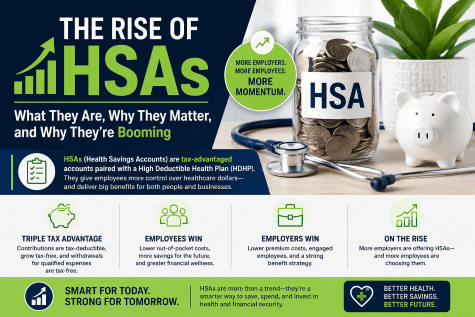
The Rise of HSAs: What They Are, Why They Matter, and Why They’re Booming
This post explains how Health Savings Accounts (HSAs) work when paired with high-deductible health plans and why they have become a core part of modern benefits. It highlights the triple tax advantage of HSAs – tax-free contributions, growth, and qualified withdrawals – and how that structure helps people manage rising healthcare costs more efficiently. The summary also emphasizes that HSAs are individually owned, rollover year to year, and can be invested, making them a powerful long-term savings and retirement healthcare tool. Finally, it notes the trends driving HSA popularity, including rising medical costs, better education and technology, and growing recognition among employers and employees that HSAs can be both a current spending tool and a future safety net.
May 15, 2026
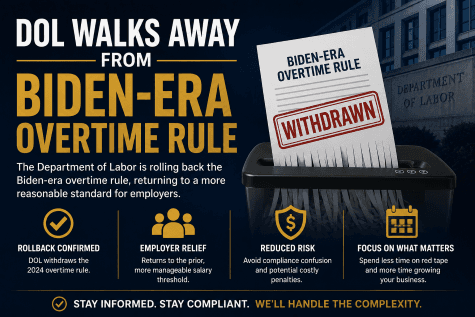
DOL Walks Away From Biden-Era Overtime Rule
The Department of Labor has officially abandoned its legal defense of the Biden-era overtime salary rule, leaving the prior 2019 Trump-era thresholds in place for white-collar exemptions. This reversal removes the immediate pressure on employers to raise exempt salaries to the higher levels that had been scheduled under the 2024 rule, but it also creates confusion for organizations that already made proactive pay or classification changes. Employers should revisit their overtime classifications, align with the restored federal standards, and monitor potential new rulemaking or state-level overtime developments that could change the landscape again.

April 27, 2026
You Hired a Remote Worker in Another State. Now What?
Hiring a remote employee in another state immediately creates payroll tax withholding, SUI registration, workers' compensation, paid leave enrollment, and labor posting obligations in that state, and those requirements apply before the first paycheck regardless of company size. The most common mistake is running payroll in the home state's setup for employees who work elsewhere, which results in unregistered accounts, incorrect withholding, and missed paid family and medical leave contributions in states like Delaware, Maine, and others with programs that launched or expanded in 2026. For Southeast businesses managing a distributed workforce, HR outsourcing or PEO services are among the most practical ways to ensure multi-state payroll compliance is handled systematically rather than discovered during a state agency audit.
April 24, 2026
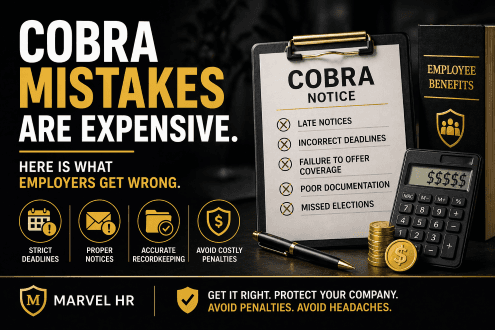
COBRA Mistakes Are Expensive. Here Is What Employers Get Wrong.
COBRA violations carry IRS excise taxes of $100 to $200 per day per affected beneficiary and separate DOL civil penalties of up to $110 per day, with both running simultaneously from the date a required notice should have been sent. Most violations are not intentional failures but process breakdowns around the 44-day notice window, incorrect premium calculations, and missed qualifying events, and outsourcing COBRA administration to a third party does not eliminate the employer's legal liability when errors occur. For Southeast businesses managing benefits administration in-house, a missed notice on a single termination can generate five-figure penalties before the issue is even identified, making this one of the clearest cases where HR outsourcing or PEO services provide direct financial protection.

April 22, 2026
Is Your Employee Handbook Working Against You? What Employers Need to Fix in 2026
The EEOC entered 2026 with a restored quorum and sharper focus on religious accommodation compliance, DEI policy scrutiny, and company-wide investigations triggered by single employee complaints, making employee handbook accuracy more consequential than it has been in several years. Federal enforcement agencies are now using documentation inconsistencies and gaps between written policies and actual practices as primary audit triggers, meaning an outdated or internally contradictory handbook creates more risk than it resolves. Southeast employers should also review non-compete and confidentiality provisions against current state law, particularly in Virginia where 2026 thresholds affect enforceability, and check that leave, discipline, and complaint procedures match how the business actually operates. For business owners without dedicated human resources support, a fractional HR or HR consulting review of existing policies is one of the most cost-effective compliance investments available heading into the second half of 2026.
April 17, 2026
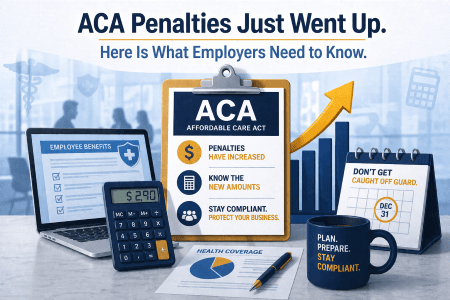
ACA Penalties Just Went Up. Here Is What Southeast Employers Need to Know
The IRS increased its ACA employer shared responsibility penalties for 2026 to $3,340 per employee under the 4980H(a) provision and $5,010 per employee under 4980H(b), representing meaningful increases over 2025 that apply to decisions employers made about last year's coverage. Most penalties are triggered not by a deliberate failure to offer benefits but by operational breakdowns in payroll accuracy, eligibility tracking, and HR data consistency. The Department of Labor also named health and welfare plan compliance, including mental health parity enforcement, as a top priority for fiscal year 2026, extending scrutiny beyond applicable large employers to any business sponsoring a group health plan. Employers who rely on manual or disconnected payroll and benefits administration systems are most at risk, and working with a PEO or HR outsourcing partner is one of the most practical ways to close that gap before a penalty notice arrives.
April 15, 2026
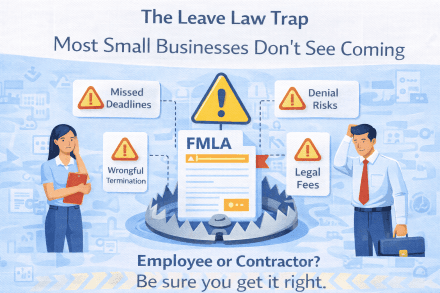
The Leave Law Trap Most Small Businesses Don't See Coming
FMLA and ADA are separate laws with different employer thresholds, different obligations, and different consequences when misapplied, and treating them as interchangeable is one of the most common leave law mistakes small business owners make. Handbook language that automatically terminates employees at the end of a fixed leave period is a per se ADA violation under longstanding EEOC guidance, reinforced again by employment law alerts published in April 2026. Mishandling leave also creates downstream payroll and benefits administration errors, including COBRA and health insurance lapses that compound the original compliance problem. Business owners in the Southeast managing HR without dedicated support should review their leave policies now, and working with a PEO, fractional HR partner, or HR consulting firm is one of the most practical ways to catch these issues before they become charges.