
April 15, 2026
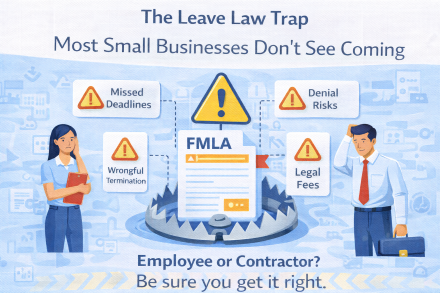
One of the most common and costly HR compliance mistakes small business owners make is treating FMLA and ADA as interchangeable. They are not. Understanding how these two laws overlap and where they diverge is one of the most important things you can do to protect your business from an EEOC charge.
FMLA applies to employers with 50 or more employees and provides up to 12 weeks of unpaid, job-protected leave. ADA applies to employers with 15 or more employees and requires reasonable accommodations for workers with qualifying disabilities, which can include additional leave beyond those 12 weeks. If your business falls between those thresholds, ADA obligations may still apply even if FMLA does not.
**The 12-Week Trap**
Many employee handbooks include language that automatically terminates employment when a medical leave period ends. That language is a liability. The EEOC has consistently held that automatic termination policies tied to a fixed leave period are a per se ADA violation when the employee has a qualifying disability.
A Parker Poe employment law alert published in April 2026 noted that employers with these policies are frequently surprised when an EEOC charge leads to a for-cause determination from the agency. The requirement is straightforward: if an employee has a disability under the ADA, the employer must conduct an individual analysis of the situation and consider whether additional leave is a reasonable accommodation before making a termination decision.
Extended or indefinite leave is not required. But a blanket policy that skips that individual analysis entirely is the problem. This is exactly the type of handbook language that a fractional HR advisor or HR consulting partner would catch in a routine policy audit.
**Common Policy Mistakes to Fix Now**
Beyond the 12-week trap, here are the policy provisions most likely to create exposure:
- Requiring employees to return to work fully recovered before you allow them back. This is an ADA violation. An employee may be entitled to return with reasonable accommodations even if they are not fully healed.
- Applying a no-fault attendance policy to employees whose absences are related to a disability. If the absences stem from a qualifying condition, automatic discipline or termination under a neutral attendance policy can trigger an ADA claim.
- Using the same medical inquiry process for both FMLA certification and ADA accommodation requests. FMLA allows detailed medical certification. ADA limits what information you can require. Treating them the same creates risk under both laws.
- Failing to document the interactive process. When an accommodation request is made, the ADA requires a good-faith, individualized conversation between the employer and the employee. Documenting every step of that conversation is critical if you ever face a claim.
Businesses managing leave across multiple Southeast states face additional complexity. Tennessee, Georgia, Florida, Virginia, and other states may have leave or accommodation requirements that run parallel to or exceed federal standards. A workforce management review that looks at each state separately is the only reliable way to stay current.
**What This Means for Your Benefits and Payroll Setup**
Leave administration is not just an HR function. It connects directly to payroll accuracy, benefits continuation under COBRA, and health insurance eligibility tracking during leave. When a leave period is mishandled, payroll errors and benefits lapses often follow, compounding the original compliance problem.
Small and mid-size businesses that handle HR in-house are most vulnerable here because leave law decisions often fall to a manager or office administrator without formal training. PEO services and HR outsourcing arrangements typically include access to trained leave administrators who manage these processes systematically, reducing the chance that a well-intentioned but legally incorrect decision creates a claim.
*Pull your employee handbook and search for any language that sets an automatic termination date tied to the end of FMLA or a fixed leave period. If that language exists, it needs to be revised before it becomes the basis of an EEOC charge.*


