
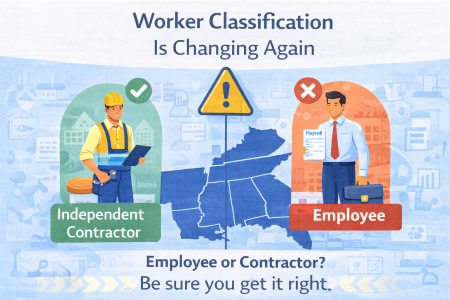
The federal rules around worker classification are in flux again, and small business owners across the Southeast need to pay close attention. The Department of Labor published a Notice of Proposed Rulemaking on February 26, 2026, proposing to rescind the 2024 independent contractor rule and replace it with a revised economic reality test. The public comment period closes April 28, 2026.
This matters because misclassifying a worker as an independent contractor instead of an employee can trigger back wages, unpaid payroll taxes, missed benefits, and civil penalties. The stakes are high whether you have two contractors or twenty.
**What the Proposed Rule Would Change**
The 2024 rule expanded the list of factors used to evaluate worker status and made it harder to classify workers as independent contractors. The DOL's 2026 proposal would roll that back and return to a version of the economic reality test that looks at whether a worker is truly in business for themselves.
In the meantime, the DOL issued Field Assistance Bulletin No. 2025-1 directing its field offices not to enforce the 2024 rule. That means today, investigators are using Fact Sheet 13 and Opinion Letter FLSA2019-6 as their guiding framework. For employers, this creates a window to get things right before the new rule is finalized.
Under the current and proposed framework, enforcement still looks at factors like control over work, permanency of the relationship, investment in equipment or tools, and whether the work is integral to the company's core operations. No single factor is automatically decisive.
**What Business Owners Should Do Right Now**
Start with a classification audit of every worker you pay as a 1099 contractor. Ask whether that person truly operates independently, sets their own schedule, works for multiple clients, and provides their own tools. If the honest answer is no, you may have a misclassification exposure.
Keep in mind that the IRS also has its own standards for worker classification under Section 530 relief, updated through Revenue Procedure 2025-10. A worker can be classified correctly for FLSA purposes and still be at risk under IRS rules. These are separate frameworks with separate consequences.
Businesses with contractors in multiple states face additional risk. Some states, including Tennessee, Georgia, and Florida, have their own classification standards that are stricter than federal law. Payroll compliance for a multi-state workforce requires reviewing each state's rules separately.
For business owners managing this without a dedicated HR team, this is exactly the type of risk that HR outsourcing or a professional employer organization can help address. A PEO or fractional HR partner can run a classification audit, flag exposure, and help you restructure contractor relationships before a complaint or audit lands.
*Review your contractor roster before April 28, 2026. If you have workers who may be misclassified, that date marks the close of the public comment period on the proposed rule and signals that federal enforcement activity could intensify once a final rule is published.*


