
April 24, 2026
COBRA compliance is one of the most penalty-heavy areas of benefits administration, and it is also one of the most commonly mishandled. For small and mid-size business owners in Tennessee, Georgia, Florida, and across the Southeast, a single missed notice can expose the business to costs that dwarf the original coverage.
The Department of Labor named health plan compliance, including COBRA administration, a top enforcement priority for fiscal year 2026 in its January update to EBSA enforcement guidance. That means the chances of a routine audit surfacing a COBRA problem are higher this year than they have been in some time.
**What the Penalties Actually Look Like**
The penalty structure for COBRA violations runs on two parallel tracks and they compound quickly.
The IRS imposes an excise tax of:
$100 per day per affected beneficiary
$200 per day if more than one family member is affected
The DOL assesses a separate civil penalty of up to:
$110 per day per qualified beneficiary for failure to provide required notices
Both penalties run simultaneously and accrue from the date the notice should have been sent. A single termination where you miss the 44-day COBRA election notice window can generate over $19,000 in combined IRS and DOL penalties before the situation is even identified.
In addition, if the former employee incurs medical expenses during the period they should have had COBRA coverage and did not, courts have held employers liable for those costs directly. Class action settlements in cases involving systemic COBRA notice failures routinely exceed $1 million. The exposure is not theoretical.
**Where COBRA Compliance Breaks Down**
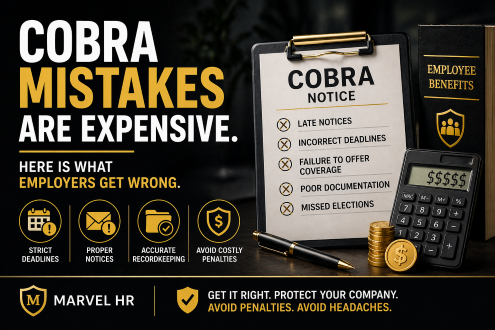
Most COBRA violations do not happen because an employer decided not to comply. They happen because the process is operationally fragile and usually owned by whoever is handling benefits administration at the time. The most common failure points are:
- Missing the 44-day window to send the election notice after a qualifying event such as termination, reduction in hours, or a dependent aging off a plan
- Treating hour reductions as a purely payroll matter without triggering COBRA coverage for the affected employee
- Using the DOL model notice as a generic template without customizing the plan-specific details the notice requires, which eliminates the good faith compliance safe harbor
- Miscalculating the premium amount, which cannot exceed 102 percent of the total plan cost for standard continuation coverage
- Missing qualifying events that are initiated by the employee or dependent rather than the employer, such as divorce, legal separation, or a dependent aging off coverage
- Outsourcing COBRA administration to a third-party administrator and assuming that eliminates employer liability. It does not. If the TPA makes an error, the employer remains legally responsible.
Southeast employers with employees in multiple states face an added layer. Forty-four states now have their own continuation coverage laws, often called mini-COBRA, that apply to smaller employers or extend coverage periods beyond federal COBRA. Tennessee, Georgia, Florida, Virginia, North Carolina, and every other state in the region have their own requirements that run separately from the federal rules.
**What a Sound COBRA Process Looks Like**
A reliable COBRA process is built around triggers and timelines, not memory. Every qualifying event needs to automatically generate a notice workflow with a documented deadline. The notice must be customized with accurate plan information before it goes out. The premium calculation needs to be verified against current plan costs each renewal cycle.
For most small businesses, this level of operational rigor is difficult to maintain in-house, particularly when the person responsible for benefits administration is also handling payroll, HR, and a dozen other functions. That is the core argument for HR outsourcing or working with a professional employer organization that handles COBRA administration as a standard part of the benefits administration function. The cost of that support is rarely more than a fraction of one COBRA penalty.
*Look at your last three employee separations and confirm that a compliant COBRA election notice was sent within 44 days of each qualifying event. If you cannot confirm that with documentation, your process needs immediate attention.*


