
February 10, 2026
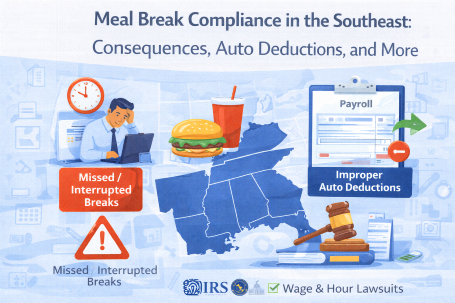
Meal break compliance varies significantly across the United States, and employers operating in the Southeast face a unique regulatory landscape where most states do not mandate lunch breaks for adult employees. However, the absence of state requirements does not eliminate employer liability. Federal wage and hour law creates strict obligations when meal breaks are provided, and automatic lunch deduction policies have become one of the most common sources of wage and hour violations and class action lawsuits. Business leaders need to understand which Southeast states require meal breaks, when automatic deductions create legal exposure, and how to structure policies that protect both the business and employees.
Meal Break Laws in the Southeast by State
The Southeast region includes states with widely varying meal break requirements, and most employers in the region are not legally required to provide lunch breaks under state law.
States with NO meal break requirement for adult employees:
States that DO require meal breaks:
For the majority of Southeast employers, meal breaks are not mandated by state law. However, this does not mean employers can ignore meal break compliance. Federal law under the Fair Labor Standards Act imposes strict requirements on how meal breaks must be handled when employers choose to provide them.
Federal Law Governs How Meal Breaks Must Be Paid
Under the Fair Labor Standards Act, employers are not required to provide meal breaks. However, when employers do provide breaks, federal law establishes clear rules about when those breaks must be paid:
The critical legal standard is whether the employee is "completely relieved of all work duties." This means the employee cannot be required to monitor equipment, answer phones, respond to emails, remain at their workstation, or perform any work related tasks during the meal break. If an employee is required to stay on call, keep a radio or pager, or remain available to respond to work needs, the meal break must be paid as working time.
Employers can require employees to remain on the premises during a meal break without triggering payment obligations, as long as the employee is free to use the time as they wish and is not performing any work duties.
Why Automatic Lunch Deductions Create Massive Legal Exposure
Automatic lunch deduction policies are timekeeping practices where the employer's payroll system automatically deducts a set amount of time, typically 30 minutes, from each employee's daily hours to account for a meal break. These policies are common in industries where it is difficult to predict exactly when employees will take breaks, including healthcare, manufacturing, retail, and customer service.
While automatic deductions are not illegal per se, they have become one of the most common sources of wage and hour violations because the system assumes the employee took a full uninterrupted break when in reality many employees work through lunch or are interrupted by work duties.
According to employment law experts and recent Department of Labor investigations, automatic deductions create liability when:
The burden falls on the employer to maintain accurate records of actual hours worked. When automatic deductions are applied regardless of whether the employee actually took an uninterrupted break, the employer is failing to pay for all hours worked, which violates the Fair Labor Standards Act.
Real Consequences from Automatic Deduction Violations
Automatic lunch deduction violations have resulted in significant financial penalties and class action settlements across multiple industries. Recent Department of Labor investigations and lawsuits demonstrate the severity of these violations:
These cases share common patterns: employees in shift based or patient care roles were unable to take uninterrupted meal breaks, but payroll systems automatically deducted the time anyway. The result was systematic underpayment that accumulated over years and affected hundreds of employees.
Under the Fair Labor Standards Act, employees who are denied proper payment for meal breaks can recover the full amount of unpaid wages plus an equal amount in liquidated damages, effectively doubling what they are owed. Employees also have the right to recover attorney fees and court costs, and they have two years to file a claim for each unpaid meal break, extending to three years if the violation was willful.
How to Structure Meal Break Policies to Avoid Liability
Employers who use automatic lunch deduction policies can reduce legal exposure by implementing the following practices:
Require employees to clock out and clock in for meal breaks. The most legally defensible approach is to have employees clock out when they begin a meal period and clock in when they return. If employees do not clock out, they are paid for the entire shift, which ensures accurate payment for all hours worked.
Implement a reporting mechanism for interrupted or missed breaks. If automatic deductions are used, employers must have a clear policy that instructs employees to report any day when they worked through lunch, were interrupted during lunch, or took a shorter break than the automatic deduction accounts for. This policy must be communicated clearly, and managers must not discourage employees from using the reporting process.
Train supervisors to identify and report missed breaks. Managers should be trained to recognize when employees are working through lunch and to document when breaks are missed so that payroll can be corrected. Supervisors who actively discourage break reporting or who pressure employees to skip breaks create significant liability.
Audit timekeeping records regularly to identify patterns. Employers should review timekeeping data to identify employees who consistently report working through lunch or who never use the reporting mechanism. If the data shows that employees are routinely unable to take breaks, the employer may need to adjust staffing levels, schedules, or workload to ensure compliance.
Do not automatically deduct rest breaks. Some employers combine a 30 minute meal period with two 15 minute rest breaks and automatically deduct an hour from the employee's workday. This violates federal law because rest breaks under 20 minutes must be paid. Only meal breaks of 30 minutes or longer can be unpaid, and only if the employee is completely relieved of duties.
How to Incentivize Employees to Take Lunch in Kentucky and Tennessee
For employers operating in Kentucky and Tennessee, where meal breaks are required by state law, ensuring compliance requires more than just offering the break. Employers must confirm that employees are actually taking their breaks and that the breaks comply with legal requirements.
Strategies to encourage compliance include:
In Kentucky specifically, where the law requires a meal break of reasonable duration between the third and fifth hours of work, employers should define what constitutes a reasonable duration in their employee handbook. Most employers use 30 minutes as the standard to align with federal unpaid break rules, but the law does not mandate a specific time.
In Tennessee, the exemption for businesses where the nature of work provides ample opportunities to eat should be applied carefully. Employers who rely on this exemption should document how the work environment provides natural break opportunities and should not use the exemption to avoid providing breaks when employees are unable to eat during their shifts.
What Employers Should Do This Week
Employers in the Southeast should evaluate their current meal break policies and timekeeping practices to identify compliance gaps. The absence of state meal break requirements in most of the region does not eliminate federal wage and hour obligations, and automatic deduction policies create significant risk if not managed correctly.
Action item for this week: Review your timekeeping system to determine if automatic lunch deductions are being applied. If so, confirm that a clear reporting mechanism exists for employees to report interrupted or missed breaks, and audit recent payroll data to identify employees who may have worked through lunch without proper compensation.


