
If you have ever looked into outsourcing your payroll and found yourself confused by the difference between a payroll company and a professional employer organization, you are not alone. The two are often marketed in similar ways, and some vendors offer both under the same roof, which makes the distinction harder to see. But they are structurally different products that solve different problems, and choosing the wrong one can leave you with gaps you do not discover until something goes wrong.
What a Payroll Company Does
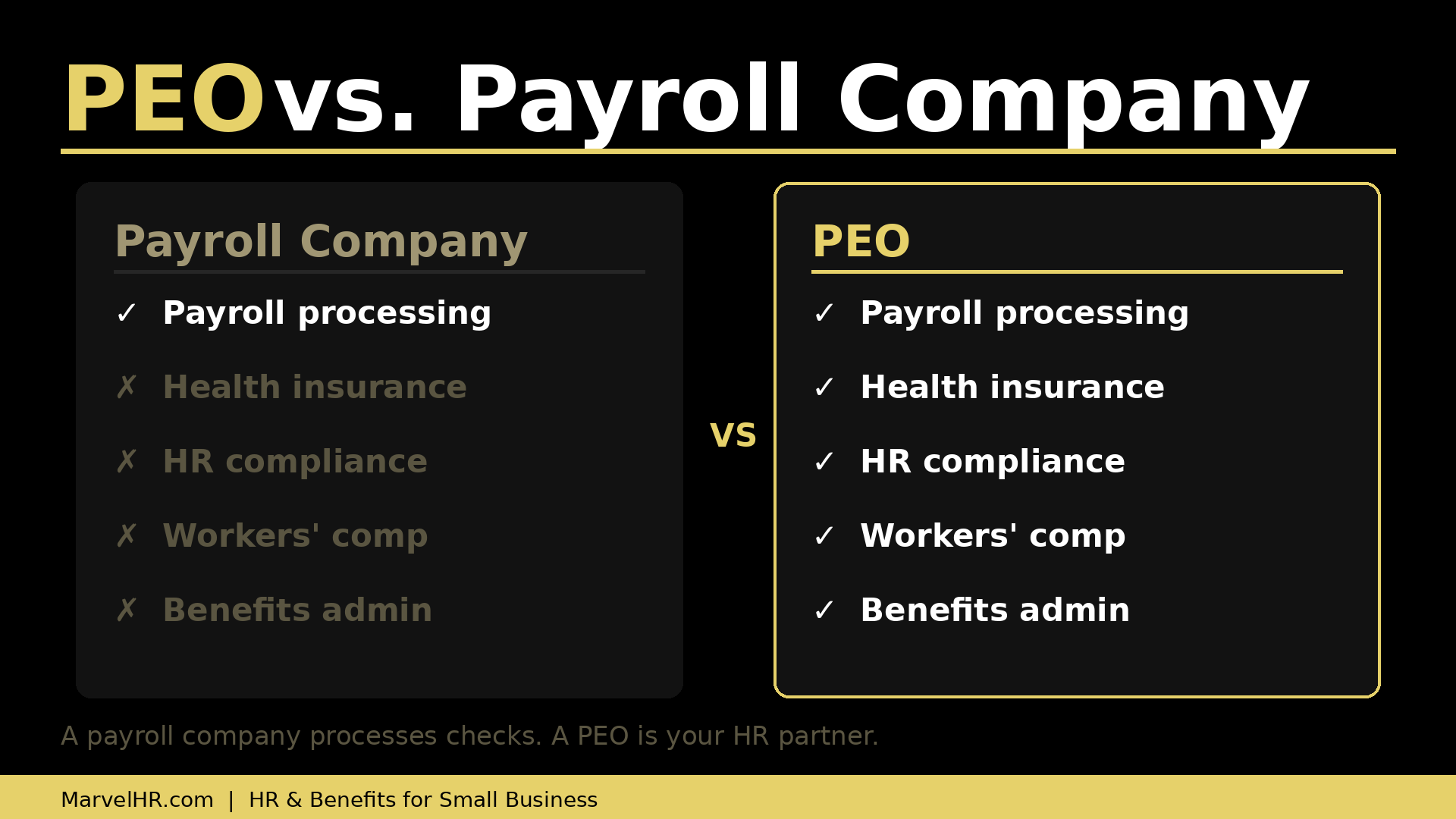
A payroll service provider does one thing well: it processes your payroll. You provide employee hours, salaries, and deductions, and the provider calculates paychecks, withholds taxes, and deposits them with the appropriate federal and state agencies. Most payroll platforms also handle W-2 and 1099 preparation, quarterly tax filings, and direct deposit. Some include time tracking integrations, basic PTO tracking, and year-end reporting.
The key thing to understand about a payroll company is that it does not share any employer responsibilities with you. It prepares and files your tax forms, but the liability stays in your name. Payroll runs under your employer identification number. If a filing is late, a tax deposit is missed, or a wage calculation is wrong, you are the responsible party. The payroll company is a processor, not a co-employer. It has no involvement in your benefits, your HR compliance, your workers' compensation coverage, or what happens when an employee files a complaint. Those remain entirely your problem.
For businesses with straightforward payroll, solid internal HR processes, and no need for help with benefits or compliance, a payroll service is a cost-effective and practical solution. The cost is typically low, the platforms are easy to use, and the administrative lift is real.
What a PEO Does
A professional employer organization enters into a co-employment arrangement with your business. Under that arrangement, the PEO becomes the employer of record for tax and benefits purposes. Your employees are technically employed by both your business and the PEO simultaneously. You retain full control over who you hire, what they do, how they are managed, and how the business operates day to day. What the PEO takes on is the administrative and compliance infrastructure of employment.
That includes payroll processing and tax remittance, but it goes significantly further. A PEO provides access to health insurance, dental, vision, life insurance, disability coverage, and retirement plans through its master benefits policies. Because the PEO pools employees from all of its client companies into a single large group, it negotiates benefits at rates that a 15-person or 40-person business could not access on its own. Small businesses that partner with a PEO can offer their employees health insurance and retirement benefits that are competitive with much larger employers. According to recent market data, PEO clients can see health insurance cost reductions of 20 to 40 percent compared to sourcing coverage independently in the small group market.
Beyond benefits, a PEO provides active HR compliance support. That includes employee handbook development and updates, state and federal employment law guidance, workers' compensation coverage and claims management, unemployment insurance administration, onboarding and offboarding processes, and assistance when employee relations issues arise. The PEO's tax remittance runs under its own employer identification number, meaning it assumes shared liability for payroll tax compliance rather than leaving that exposure entirely with your business.
The Structural Difference That Actually Matters
The simplest way to explain the difference is this. A payroll company is a tool. A PEO is a partner.
When you use a payroll company, you are buying software and processing capacity. The vendor has no stake in whether your handbook is compliant, whether your workers' compensation coverage is adequate, or whether you are classifying employees correctly. When something goes wrong on the HR or compliance side, you handle it alone or pay separately for an attorney, a benefits consultant, and an HR professional.
When you work with a PEO, you are entering a relationship where another organization shares responsibility for the employment infrastructure of your business. That organization has a financial and operational interest in keeping your HR practices sound because its name is on the employer of record documentation. That shared accountability changes the nature of the service.
The practical tradeoff is cost and control. A payroll company costs less and leaves you in full control of your HR decisions with no co-employment structure to navigate. A PEO costs more on a per-employee basis but provides services that would otherwise require multiple vendors, an internal HR staff member, and a benefits consultant to replicate. For most businesses that choose a PEO, the math works because the benefits savings, the time recovered from HR administration, and the compliance support offset the cost difference.
Which One Is Right for Your Business
A payroll company is likely sufficient if your business has fewer than 10 employees, you have a reliable benefits broker relationship already in place, you have internal HR capacity or a low HR complexity level, and your primary need is just to get people paid accurately and on time.
A PEO is worth evaluating if you are spending significant time on HR and benefits administration, your health insurance costs have increased substantially at renewal, you operate in multiple states and are struggling to keep up with varying compliance requirements, you are growing and want to offer competitive benefits to attract and retain employees, or you have had an HR compliance issue and realized you lack the infrastructure to handle it properly.
The size range where PEOs tend to deliver the most value is roughly 10 to 150 employees. Below that, some PEOs have minimum requirements or pricing structures that do not pencil out. Above it, larger businesses often have the scale to build internal HR capacity more cost-effectively than paying PEO fees. But within that range, the combination of benefits access, compliance support, and administrative relief is difficult to replicate at a comparable cost through any other arrangement.
HR outsourcing through a PEO is not a fit for every business. But for the small business owner who is currently managing payroll on a platform, sourcing benefits independently at small-group rates, handling compliance questions as they come up, and hoping nothing falls through the cracks, the gap between what a payroll company provides and what a PEO provides is worth understanding clearly before the next renewal season.
Action item: Pull your current per-employee cost for health insurance and compare it against what a PEO quotes for the same coverage level. That single comparison will tell you more about whether a PEO makes financial sense for your business than any other data point.


