
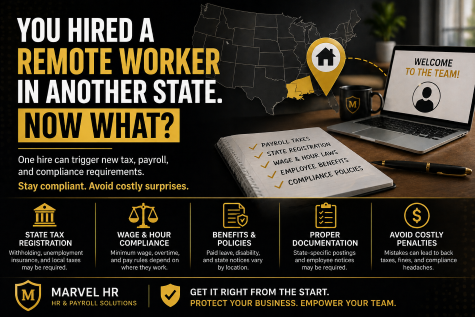
One of the fastest-growing compliance problems for small and mid-size businesses in 2026 is also one of the least visible. When a business based in Tennessee, Georgia, or Florida hires a remote employee who works from a different state, that hire creates legal obligations in the employee's state immediately and automatically. Most business owners do not realize what those obligations are until a state agency sends a notice.
The core principle is straightforward: employment law follows the employee, not the employer. The state where your remote worker sits and performs their job determines which wage laws, tax withholding rules, unemployment insurance accounts, leave programs, and labor postings apply. Your home state's rules do not travel with you.
**What You Are Required to Do Before the First Paycheck**
For every state where a remote employee works, a business typically needs to complete all of the following before the first payroll run:
- Register for income tax withholding in the employee's work state
- Register for state unemployment insurance (SUI) in the work state, which is separate from your home state SUI account and has its own rate and filing calendar
- Obtain workers' compensation coverage that satisfies the work state's requirements
- Enroll in any mandatory paid family and medical leave program the work state administers
- Provide the state-specific labor law postings required in that state, which may need to be delivered electronically for fully remote workers
- Complete new hire reporting in the work state within the state's required window
These are not optional steps that apply only to large employers. Most of them apply from the first employee you have in a state, and penalties for late registration begin accruing from the date you should have registered.
Paid family and medical leave is one of the fastest-moving areas. As of April 2026, 13 states and Washington D.C. operate mandatory PFML programs. Delaware launched its program with benefits starting January 1, 2026. Maine began paying benefits May 1, 2026. Maryland begins contributions in January 2027 with benefits following in 2028. If you have a remote worker in any of these states, you have enrollment and contribution obligations that run through your payroll system.
**The Mistakes Southeast Employers Make Most Often**
The most common multi-state payroll compliance error is also the simplest: using the home state's setup for an employee who moved or was hired remotely in another state. Payroll is configured once, run in the home state, and never updated to reflect where the employee actually works. This results in the wrong state receiving income tax withholding, no SUI contributions going to the correct state, and no enrollment in the applicable leave program.
Other frequent errors include:
- Missing an employee relocation entirely. When an existing employee moves to another state and continues working remotely, that move triggers the same registration and withholding obligations as a new hire. Many employers are not notified when this happens, and payroll compliance gaps accumulate quietly over months or years.
- Applying the home state's minimum wage when the work state's minimum wage is higher. The FLSA requires the higher of the federal, state, or local minimum wage, and several states significantly exceed the federal floor.
- Using the home state's overtime exemption salary threshold when the work state requires a higher amount. In 2026, Washington state requires a minimum salary of $1,541.70 per week for overtime exemption. Colorado requires $1,111.23 per week. California requires $1,352 per week. The federal threshold is $684 per week. If you have employees in these states, the federal threshold does not protect you.
- Missing reciprocity agreements between neighboring states that could simplify withholding for employees who live in one state and work in another.
For Southeast employers, this most commonly surfaces when a Tennessee, Georgia, or Florida-based company hires someone working remotely from Virginia, North Carolina, Texas, or another nearby state. Each of those states has its own payroll registration and compliance requirements.
**What Good Workforce Management Looks Like for Multi-State Teams**
The businesses that stay clean on multi-state compliance treat it as a system, not a one-time setup task. Every time an employee is hired in a new state or relocates, a registration workflow fires before the first payroll run. The payroll system reflects the actual work state for every employee. Leave program enrollments are tracked and updated as state laws change.
This level of operational consistency is difficult to maintain in-house, especially for businesses without a dedicated HR or payroll compliance function. HR outsourcing arrangements and PEO services are specifically structured to handle multi-state registrations, maintain state-specific payroll configurations, and track the paid leave and benefits administration obligations that come with a distributed workforce. For a business with even two or three remote workers across state lines, the cost of those services is typically far less than the cost of correcting unregistered accounts and back-filing payroll taxes.
*Make a list of every state where at least one of your employees physically works today. For each state other than your home state, confirm you have active income tax withholding and SUI registrations. If any registrations are missing, open them before your next payroll run.*


