
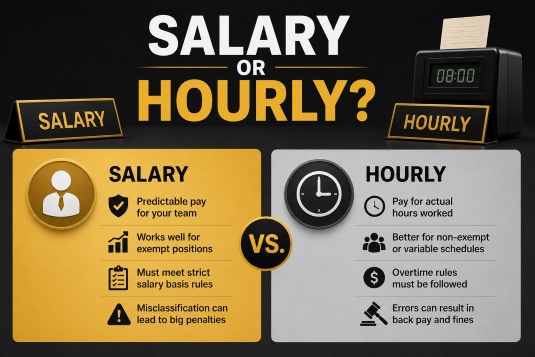
Effective yesterday, the Department of Labor has updated the minimum wage rate for workers on covered federal contracts to $13.65 per hour for non-tipped employees. That change is narrow and affects only businesses with certain federal contract work. But it lands on the same day that overtime misclassification remains the single most common source of DOL back wage findings in the country, accounting for nearly 80% of all FLSA violations the Wage and Hour Division recovered in 2025.
For most small and mid-size employers in the Southeast, the bigger issue is not the federal contractor wage rate. It is whether the people on your payroll are classified correctly as exempt or non-exempt in the first place.
How the Three-Part Test Actually Works
The FLSA does not let employers choose whether an employee is exempt from overtime. It sets out a specific three-part test, and all three parts must be met. If any one part fails, the employee is non-exempt and overtime applies.
The three requirements are:
- Salary level: The employee must earn at least $684 per week, which equals $35,568 annually. The DOL has confirmed it is enforcing this 2019 threshold after the 2024 overtime rule was vacated by a federal court in November 2024.
- Salary basis: The employee must receive a fixed, predetermined salary that does not change based on hours worked. You generally cannot dock a salaried exempt employee's pay because they worked fewer hours in a given week.
- Duties test: The employee's primary job duties must qualify under one of the recognized exemption categories.
The duties test is where most employers get into trouble. The three most commonly claimed exemptions for office and management roles are the executive, administrative, and professional exemptions.
The executive exemption applies when the employee's primary duty is managing the business or a recognized department or subdivision, they regularly direct the work of at least two other employees, and they have genuine authority to hire, fire, or materially influence those decisions. Giving someone the title of manager does not satisfy this test.
The administrative exemption covers employees who perform non-manual work directly related to business operations or management and who exercise real discretion and independent judgment on significant matters. Processing routine transactions, following standard procedures, or carrying out instructions does not qualify.
The professional exemption applies to work requiring advanced knowledge in a field typically obtained through a prolonged course of specialized instruction, such as attorneys, licensed healthcare professionals, engineers, and accountants with CPA credentials.
Where Southeast Employers Make the Wrong Call
The most common misclassification pattern in small businesses is treating a salaried employee as automatically exempt. Salary alone does not determine exempt status. A salaried employee earning $50,000 a year who works as a customer service lead, an office coordinator, or a low-level supervisor without real management authority is almost certainly non-exempt and entitled to overtime pay.
The second most common pattern is misclassifying a role based on what a previous owner or manager did. If you inherited a classification that was never formally reviewed, you are carrying the prior employer's exposure.
For multi-state employers in states like Tennessee, Georgia, Virginia, North Carolina, and Florida, the federal threshold is the floor. Some states maintain their own overtime rules or salary thresholds. Virginia and several others have provisions that interact with FLSA requirements in specific ways. If you have employees working remotely in different states, each state's rules apply to the work performed in that state.
The DOL Wage and Hour Division recovered nearly $260 million in back wages for more than 175,000 workers in 2025. Back pay under the FLSA can go back two years, and three years if the violation is found to be willful. Willful means the employer knew the law applied or showed reckless disregard for whether it applied. That is a low bar, not a high one.
For businesses working with a professional employer organization or an HR consulting partner, classification audits are a standard part of workforce management support. For those handling it internally, the right starting point is to pull up every salaried role, apply the three-part test to the actual job duties, and document the reasoning. The employer carries the burden of proving an exemption applies. If the documentation is not there, it will not hold up.
*This week, identify every salaried employee in your business earning less than $50,000 annually and confirm whether they actually meet the duties test for the exemption you have applied to them. If the answer is not clearly yes, reclassify before a wage complaint forces the issue.*


